

A Baker's Dozen
...as served up by Henry Kaiser, guitar player

Henry Kaiser comes from good stock—his grandfather’s company was a vital part of the construction of the Hoover Dam and his post-war company Kaiser Permanente modernized the health care industry. But Henry opted for a different path in life, one defined by a predisposition for adventure and nurtured by consistent artistic growth. Born in Oakland, California and a product of the Bay Area, Kaiser is one of the pillars of American free improvisational guitar, with a storied career that spans not only decades, but a vast array of disciplines and approaches that go beyond guitar playing and even music—Kaiser is an accomplished research diver and underwater cinematographer, which means he has filmed what happens underneath the glaciers of Antarctica. (No offense to Eric Clapton, but when was the last time he strapped on a scuba suit?) Kaiser has worked on three Werner Herzog films, first producing Richard Thompson’s soundtrack for Grizzly Man and then providing camera work on The Wild Blue Yonder and Encounters at the End of the World, for which he and David Lindley wrote the score. For his role as a producer on 2007’s Encounters…, Kaiser was nominated for an Academy Award for Best Documentary; but it was his appearance on a 2005 tribute album for 19th century composer Stephen Foster—”the father of American music”—that won Kaiser a Grammy. He may brave subzero waters with hi-tech camera equipment, but when it comes to the guitar, Kaiser is truly the master of his domain.
Two of Kaiser’s primary inspirations come from parallel streams in the American counterculture, both of which run through California: The Grateful Dead and Captain Beefheart and His Magic Band. Kaiser was a devotee of both bands, and had a particular knack for understanding The Magic Band’s baroque compositions and intricate guitar lines. Magic Band guitarist Bill Harkleroad (aka Zoot Horn Rollo) noted that Kaiser had transcribed the entirety of Trout Mask Replica and could play the classic double album front to back—maybe one of the few people in the world with that capability. Kaiser’s Beefheart-inspired group, Crazy Backwards Alphabet, counted John “Drumbo” French from The Magic Band among its ranks, and their 1987 LP on SST featured artwork from The Simpsons creator Matt Groening. In fact, Henry Kaiser may be the only musician to have releases on both SST and Windham Hill, the distance between those two iconic labels proving how wide his scope is. He has collaborated with a broad spectrum of musicians, including Fred Frith, Derek Bailey, Herbie Hancock, Richard Thompson, John Zorn, Diamanda Galas, and Zakir Hussain. He has traveled to Madagascar, Norway, and Myanmar to record and learn to play the music indigenous to each region.
Over the course of five decades, Kaiser has appeared on north of 300 albums. For many of the Bandcamp versions of older albums, Kaiser adds supplemental material recorded alongside the previously published editions, giving the listener an even more extensive view of the Kaiser dialectic. Below are 13 releases, a deep dive if you will, into the oeuvre of master guitarist Henry Kaiser.
Henry Kaiser, John Oswald
Improvised
Recorded at various dates during a 1978 tour, Improvised finds Kaiser teaming up with John Oswald. Playing alto saxophone, Oswald alternates between upper register squeaks and squawks and drawn-out phrases that sound like a tea kettle left to boil and then abandoned. Kaiser chases him around the higher frequencies while also providing a mesmerizing bed over which Oswald can vamp in his own strange way. “Vancouververiffication” is an extended piece with Oswald mouthing reed-rattling bleats and fits of angry humming while Kaiser works through lyrical passages by leaning on the whammy bar and conjuring swells of billowing feedback. In the 1980s, Oswald’s experiments with sampling were defined by his concept of “plunderphonics,” and he again found common ground with Kaiser via his Grateful Dead-sourced Grayfolded set. In contrast, on Improvised, the music is as unadorned and spontaneous as it gets.
Outside Pleasure
1980’s Outside Pleasure is all Kaiser, and it illustrates the ways he transcends the limitations imposed on the electric guitar by those lacking in imagination. Kaiser can make his guitar sound like an airplane coming in for a landing, a gaggle of ducks converging on a pond, or an entire orchestra tuning up. Not only are Kaiser’s technical skills on another level, he is a wiz with FX, utilizing the latest digital rack gear for delay and modulation—until the boutique pedal industry caught up with him and gave him the ability to rip open time and space. “Punctual As Actual” and “An Economy of Scale” are drenched in distortion and digital delay artifacts, as Kaiser wrenches violent, skittering sounds from his guitar, while “The Stormy Present” incorporates a radio broadcast into Kaiser’s chaos, eventually taking over the track as he signs off with piercing feedback. “Aquirax Aida” is a tango between the volume knob and the tremolo bar, prefiguring the fluctuating riffs of ‘90s avant-rock paragons U.S. Maple. Kaiser even indulges his sentimental side with run-throughs of “Jingle Bells” and “It Came Upon A Midnight Clear” by exposing their origins as “parlour poems” like an audio version of Wikipedia.
Aloha
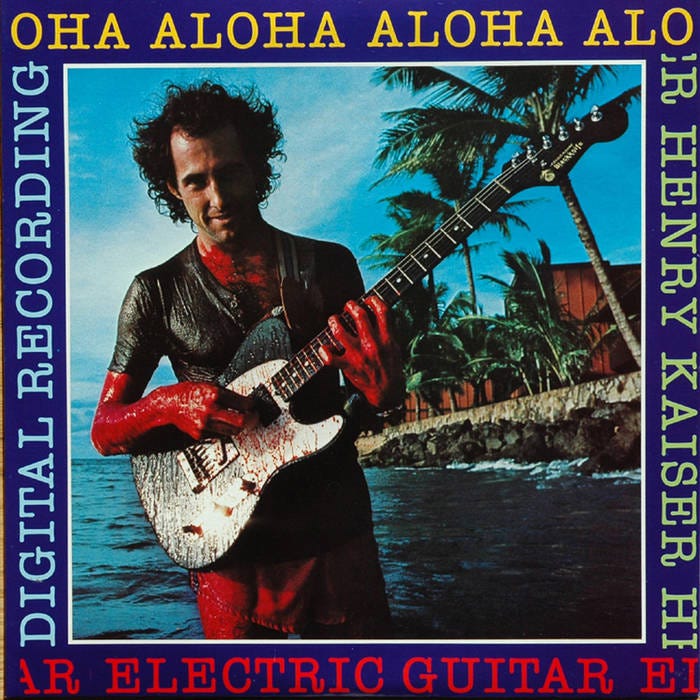
The title of Aloha implies a greeting—something friendly; but the slide-dominated 19-minute opening cut “The Shadow Line” is rife with a menace that verges on the industrial. On the cover, Kaiser is pictured in the surf, surrounded by palm trees, but he’s covered in red paint that looks like blood—these waters are shark-infested and the guitarist is in the cage, serenading some of the fiercest predators on Earth. It’s fun to hear Kaiser perform a version of free improv shredding on tracks like “Christmas at Bear Mountain,” “The Empty Set,” and “Joaquin Miller.” “Aloha Gamera” is the other side-long piece on this double album, and it’s a spring-loaded trap full of barbed wire. It’s hard to tell who’s more dangerous at this point—the sharks or Kaiser? But Kaiser really catches you off guard during the last quarter of Aloha when guests join him—Bob Adams helps make “The Book of Joel” sound like Robert Fripp covering John Fahey, Greg Goodman provides torrents of Cecil Taylor-like piano on “Kawaita Hana - Pale Flower,” and John French joins him for Beefheart-style rockers “Lynn’s Mad Money” and “Future-Jinx Blues.”
It’s A Wonderful Life
1984’s It’s A Wonderful Life shows Kaiser further refining his style with a slick recording that crystallizes so many of the ideas that the guitarist was exploring. On the title track, he duets with himself in Steve Reich-like patterns while building layers of soaring leads that arc over top of the landscape like spires. By this point, Kaiser was also delving into a style of computer music that was being made at forward-thinking universities such as Mills College nearby in Oakland. On “Let’s Drink 100% Healthy Milk And Study Hard!” Kaiser plays on top of a web of synthetic sounds that is just shy of cacophonous and seems to predict the meticulous sound collages of Matmos (who also began in the same environs). “The Book of Gold” is an exercise in the Derek Bailey school of harmonic chime, attack, sustain and release (after Bailey passed, Kaiser dedicated an album to him). Playing with elements of smooth jazz, “Ear Trouble” pushes tonal extremes as Kaiser filters his playing through effects, mimicking the sounds of stringed instruments from around the world, and on planets yet undiscovered.
Re-Marrying For Money
Recorded in the early ‘80s and originally released in 1986 as Marrying For Money, SST reissued the album as Re-Marrying For Money in 1988, with added tracks. Backed up by the rhythm section of Hilary (bass) and John (drums) Hanes (formerly the Stench Brothers of new wavers Pearl Harbor & The Explosions), Re-Marrying For Money is Kaiser in streamlined jazz-rock mode, ripping tasteful but electrifying solos over top the busy bass and drums. You can imagine tracks like “T-Men” and “Mr. McGuffin” being played at L.A.’s chicest sushi restaurant circa 1989 while Hollywood producers court A-list actors. Speaking of the A-list, Money has some upper echelon guests, including Glen Phillips of Hampton Grease Band, Bruce Anderson from MX-80 Sound, jazz great John Abercrombie, jack-of-all-trades Bill Frisell, journeyman Amos Garret, and others.
The Five Heavenly Truths
The Five Heavenly Truths collects a number of Kaiser’s collaborations and performances throughout the early ‘90s. On “The Best of Times” and “The Worst of Time,” Kevin Gross plays a sampler while Kaiser answers with his MIDI guitar, providing waves of granular rhythms and alien textures. Performed by a jazz ensemble with two drummers, “Project X” is like Ornette Coleman as interpreted by Raymond Scott. On “Logic of Fire,” poet Vernon Edgar takes a turn on the mic and his Van Vliet-ian lilt circles Kaiser’s avant-blues guitar licks like they’re sizing each other up. It’s a winning combination. The Bandcamp version of Truths doubles the length with a set of tracks that touch on Dead-like jamming and an assortment of jazz styles which range from chill and relatively straightforward to intense flare-ups with blazing Kaiser leads.
Henry Kaiser, Greg Goodman, Lukas Ligeti
Heavy Meta
Recorded in 1996 but not released until 2002 on Thurston Moore and Byron Coley’s Ecstatic Yod label, Heavy Meta finds Kaiser performing live improvisations with pianist Greg Goodman (with whom he had formed the Metalanguage label in 1977) and drummer Lukas Ligeti (son of famed composer György Ligeti). Kaiser mostly plays acoustic guitar, but also takes up the bass for a few tracks. The interplay between the trio is playful but frenetic, with Goodman taking off on rapid-fire runs up and down the keys as Ligeti keeps the pulse moving while finding time to add non-rhythmic textures and holding back to open up space; meanwhile, Kaiser tries to keep up with the piano, and the acoustic resonance is much more forgiving than the implicit volume of an electric guitar. The epic “War & Piece” is a thrilling jumble of sounds that ranges from frantic attack to sections of contemplation that constantly undercuts sentimentality and remains airy. Except for a short track with Kaiser on electric guitar, the album is dense with action, but airy in its composition.
Henry Kaiser, Wadada Leo Smith
Yo Miles!
In the late ‘90s, Kaiser and trumpeter Wadada Leo Smith started the Yo Miles! band to pay tribute to the jazz great’s innovative mid-’70s large ensemble funk rock fusion era. In the mid ‘00s, they made two double CD albums of Miles covers and originals in a similar style. Featuring players like Zakir Hussain and John Tchicai, this collection compiles a selection of these original compositions. The manner in which the band—led by Smith and Kaiser—summon the very particular magic of Miles’ still-revolutionary music is remarkable, bordering on uncanny. On 20+ minute cuts like “Shinjuku” and “Who’s Targeted?,” the group runs the voodoo down so thoroughly that it’s like being transported to the Fillmore East with a thick cloud of smoke in the air. You might have to throw your clothes in the wash when you get home, but it is well worth it.
Henry Kaiser, Charles K. Noyes, Weasel Walter
Ninja Star Danger Rock
This 2011 set of no wave splatter rock was recorded in Lagos, Nigeria by a trio made up of Kaiser with drummer Charles K. Noyes (Toy Killers) and bassist Weasel Walter (Cellular Chaos), and it is bracing stuff. Kaiser navigates his pedalboard like he’s playing a first-person shooter video game and he’s surrounded by zombies, blasting out laser gun sounds and burping out noise sludge. On the lengthy, muckraking “At This Late Date, the Charleston,” Kaiser makes his guitar sound like a Korg MS-20 synthesizer as he unleashes modulating waves of ill-tempered frequencies like a robot with a fever.
My Favorite Licks Vol. 1
On this digital-only release, Kaiser compiles a selection of his personal faves, many taken from split albums he appeared on with other solo artists. From the weird noise of “The Best of Times” to the relatively straightforward acoustic blues of “Devil Got My Skippy” to the patient, elegiac beauty of “A Precise Kind Of Infinity, A Sliver Of Clarity Nestled,” to the fingerstyle plucking of “At Two” and the Derek Bailey-isms of “Dropped D Monteleone,” My Favorite Licks provides an excellent overview of the Kaiser method(s).
Henry Kaiser/Nels Cline/Jim Thomas/Weasel Walter/Allen Whitman
Jazz Free
Guitarist Nels Cline met Henry Kaiser way back in 1977, but the pair had only made one recording together (Cline plays on the Yo Miles! band’s 1998 debut) before the “rock improvisation” suite Jazz Free. The cover of this 2012 offering (“A Connective Improvisation”) mimics the cover of Ornette Coleman’s epochal 1961 album Free Jazz and links the master guitarists up with third guitarist Jim Thomas and bassist Allen Whitman, both from San Francisco psychedelic surf rockers Mermen, as well as Weasel Walter again, this time behind the drum kit. Despite the playful antipathy towards the genre, the quintet operates like a jazz combo, applying the dynamics of themes, heads, and solos to soaring psychedelic workouts like “Farewell to the Master” and “Coastal Ballad.” The title track wades into noisier, more aggressive waters whereas “Asstinato” looks back to Miles’ electric era. “Sunshine On” rocks with a Minutemen-like jitter, while “Mass Projection Jim > Fake Xero” shows the trio of guitarists effortlessly trading off solos like a virtuoso Dead tribute band on a Hawaii-bound cruise ship.
Nazca Lines
Nazca Lines is Kaiser in a stripped-down setting, played entirely on acoustic guitar. Kaiser actually uses the “Introduction” to speak directly to the listener, explaining the phenomenon of Nazca lines, how Derek Bailey’s approach influenced him, and why he’s made this particular record, which consists of 22 improvised solos played on 18 different guitars. Despite the brevity of the pieces, Kaiser is in a contemplative mood, moving between luminous clouds of ringing harmonics and deeply felt strumming and finger-picking. While most of the tracks fall on the shorter side, by the time he gets to the end of the album, Kaiser is ready to stretch out on “Hands,” “Astronaut” and “Reptile.” On “Whale,” he grinds the pick against the strings, reveling in the tactile and seizing the moment.
The Deep Unreal
Considering his later career, perhaps it’s more than a coincidence that Kaiser’s very first album from 1977 was entitled Ice Death. The liner notes to 2017’s The Deep Unreal explain that “immediately after returning from his 12th deployment to Antarctica as a Scientific Diver, Henry Kaiser recorded this musical translation of 43 scientific dives installing an underwater remote sensing system under the ice near McMurdo Station.” The liner notes clarify that The Deep Unreal is “live solo guitar all improvised no overdubs just long delays and no looping” and the result is a hypnotic work that rewards close listening but also serves as a sort of ambient blues that recalls Robert Fripp, Richard Pinhas, even Roy Montgomery. The title track is a 26-minute expedition to the polar depths, accruing a glaciality that feels primordial. Calling back to his debut, “A Spoonful of Ice Death Blues” is an extended meditation that opens with Kaiser dancing around the theme like a moth fluttering around a lightbulb until a third of the way through he steps on the overdrive, arcing into Hendrix-y leads before he starts messing with the delay settings and the ice death blues turn into a frozen death rattle. It’s a watery grave, but it’s beautiful and serene and there’s no other place like it on the planet.